


The Hollow Man (BTS Blog)
- The Storysmith

- Mar 11, 2025
- 3 min read
Updated: Mar 12, 2025
The Making of The Hollow Man: A Look Behind the Scenes
I want to share some of my thoughts on the development of The Hollow Man, a project that earned me a win in a Discord community contest.
The idea started with a simple but intriguing question: What if Halloween had a dark, real-world origin? I wanted to create a lore that felt grounded in reality yet evolved into the eerie and haunting tradition we recognize today.
If you haven’t watched The Hollow Man yet, I recommend checking it out first and then circling back here for a behind-the-scenes look at its creation:
Crafting the Origin of The Hollow Man
I set the story in the 1800s, partly because the assets I had on hand fit that era best. The entire project was filmed in Unreal Engine 5, allowing me to construct a visually immersive world.
At its core, the story follows a serial killer who finally gets caught and executed—but his death gives birth to something far worse. A curse settles over the town, passed down through generations via whispered campfire stories.
Over time, legend became myth, and myth became Halloween.
Though the short film only scratches the surface of this concept, my intent was always to suggest a deeper lore lurking beneath the surface.
Building the World and Filming in Unreal Engine
My first step was rough storyboarding—and I do mean rough. I can’t draw, so I relied on stick figures and basic shapes to map out my ideas. Even with their simplicity, storyboards help me translate abstract thoughts into something tangible.
With the framework set, I began crafting the town. When working in a virtual environment like Unreal Engine, optimization is key—you don’t need to render an entire world, just what the camera sees. I built only the essential sets: the execution path, the gallows, and a few nearby streets where I could film additional scenes, such as the opening sequence and the Hollow Man’s face glitching moment.


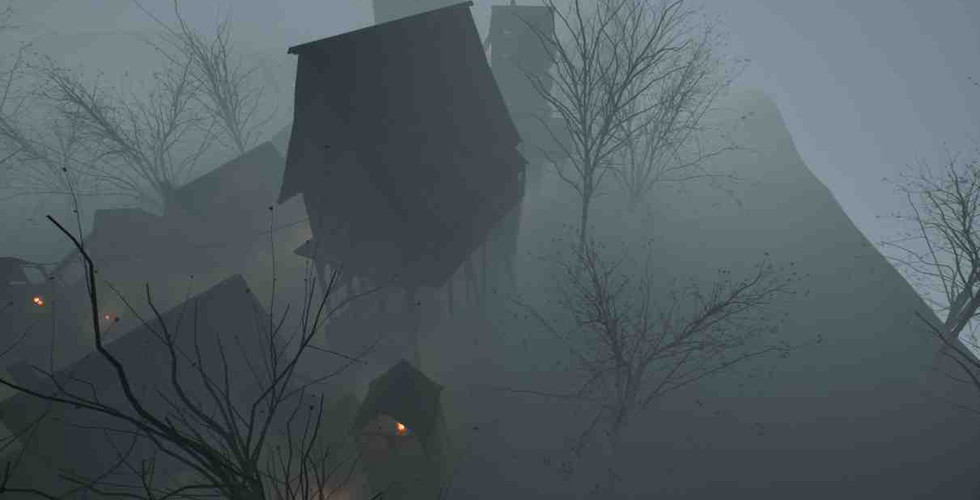


One of the biggest challenges in horror filmmaking is balancing darkness and visibility. Every screen displays black levels differently, meaning some viewers might see a scene as too dark while others find it washed out. This is where color grading comes into play. Despite my best efforts, The Hollow Man ended up slightly lighter than I had envisioned. But ultimately, I let it be—the atmosphere was eerie enough to carry the tone I wanted.
Storytelling Through Cinematics
From a narrative standpoint, I followed a classic structure:
Establish the "normal world" – The opening introduces a victim, setting the stakes.
Introduce the horror – The killer is caught, and tension builds.
The execution – His death should bring closure, but instead, it unleashes something worse.
The curse begins – The true horror isn’t the man himself, but what he becomes.
I recorded my voice and used an AI voice changer to affect the tone to guide the storytelling, reinforcing the eerie, folklore-like quality of the legend. Originally, I had planned for a more lived-in town, with people peeking from windows or running from the captured murderer. However, I chose to push forward rather than get stuck perfecting every detail.
Execution Scene: From Vision to Reality
One of my biggest creative hurdles was executing (pun intended) the execution scene itself. My original vision was a seamless transition:
The sword swings down.
The camera follows the motion.
Just as the head is severed, it jump cuts to a pumpkin being placed down, symbolizing the transformation into the Hollow Man.
While the final cut didn’t quite match my initial concept, I had to embrace imperfection and move forward. I often struggle with perfectionism, but I’ve learned that finishing a project is more valuable than endlessly refining it.
Final Thoughts
This project was a challenge, but also a blast to work on. I developed The Hollow Man in just two weeks, and while there are elements I’d like to refine, the beauty of filmmaking is that you can always revisit and improve your work.
Filmmaking is more than just visuals—camera movement, lighting, framing, and shadows all contribute to storytelling. Every detail should serve a purpose, shaping how the audience experiences the narrative.
So now, I turn the question to you:
What are some of your favorite movie scenes that evoke strong emotions or masterful storytelling? Let’s discuss in the comments!
Comments